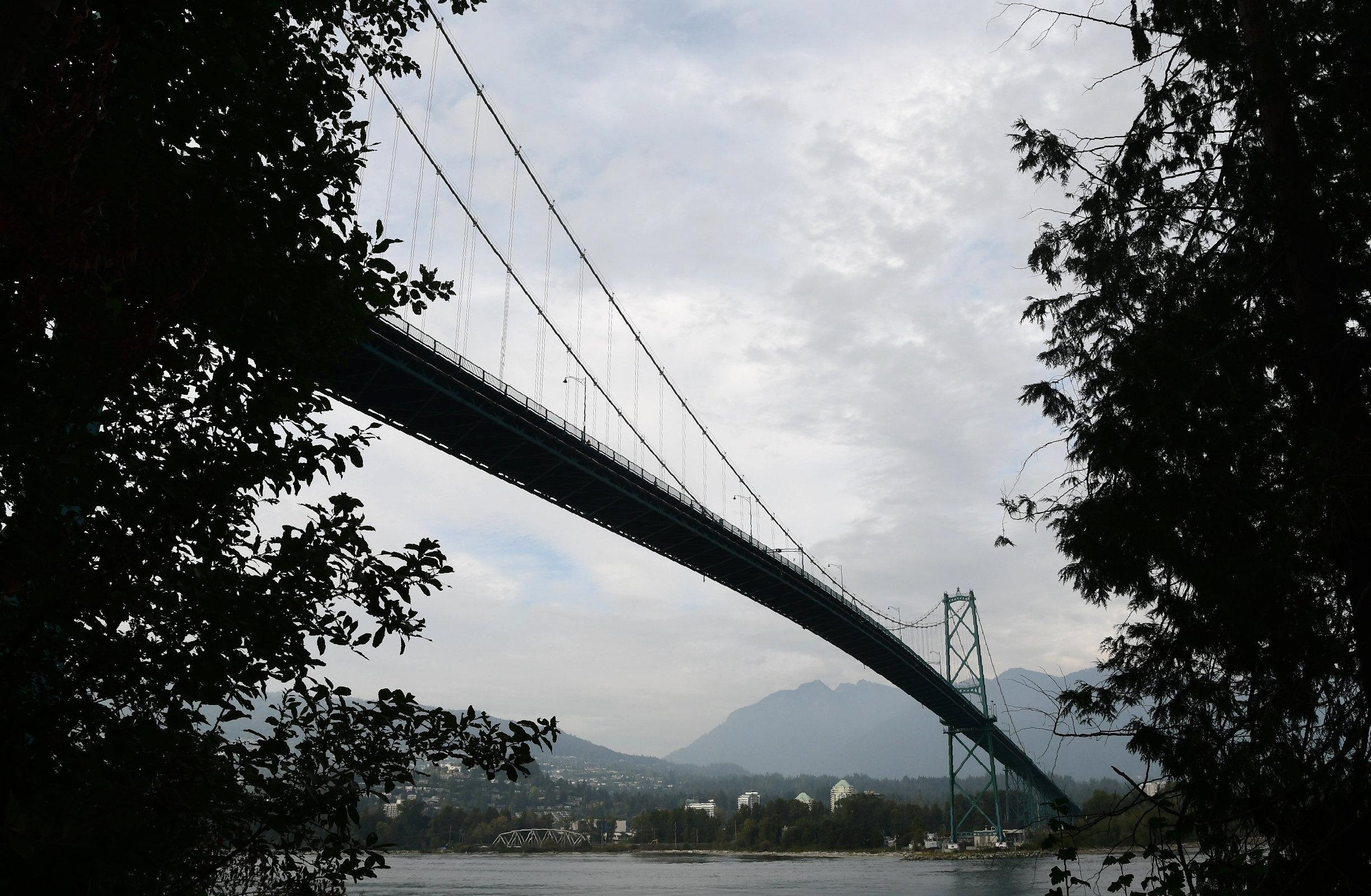
Vancouver is a coastal city interlaced with bays and river channels, which makes bridges indispensable to daily life. Among its most famous are the Capilano Suspension Bridge and the Lions Gate Bridge. Of these, the Lions Gate Bridge stands as both a symbol of the city and one of its most vital transport links.
My first encounter with the Lions Gate Bridge was while driving from my home in South Vancouver to a doctor’s office on the affluent North Shore. After passing through downtown, the road cut through the forested heart of Stanley Park. Suddenly, the green steel bridge—with its two lion statues standing guard—appeared before me. Just moments earlier, I had been surrounded by towering trees; now, I was driving high above the ocean, with the sea stretching endlessly on both sides. The sudden shift was dazzling with its impact was both visual and physical. The bridge is relatively narrow, with only three lanes, and as cars sped past, I felt an uneasy thrill—as though one careless turn of the wheel could send me off the edge. Even inside the car, I could feel the vibration and hum of the deck, as if the whole bridge trembled with each passing vehicle.
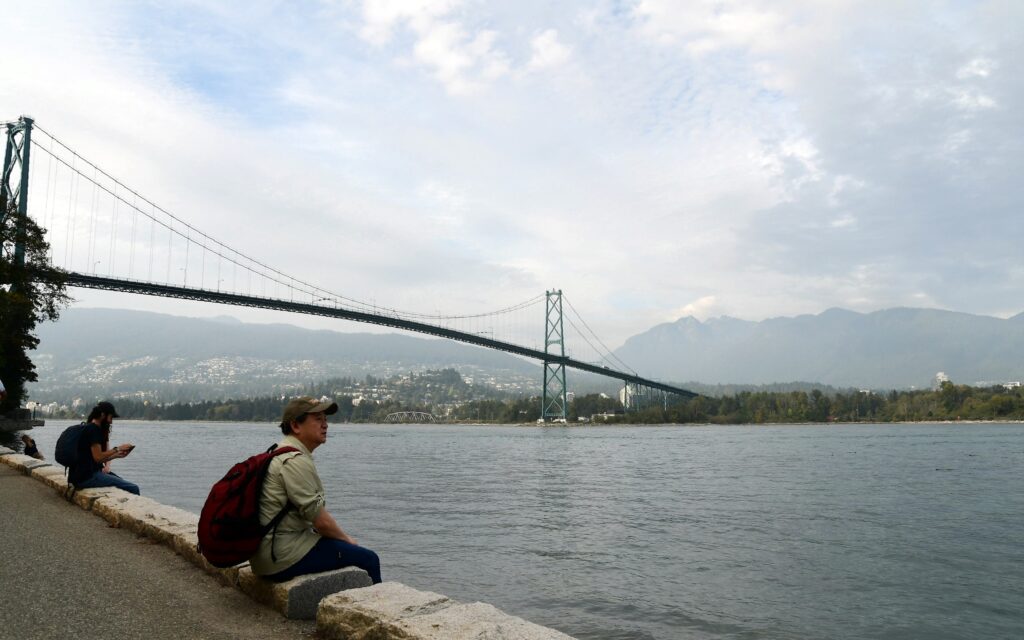
Though the speed limit is 80 km/h, few seem eager to reach it. Perhaps the view is too awesome—drivers instinctively slow down to take it in. Or maybe, like me, many simply have a touch of vertigo.
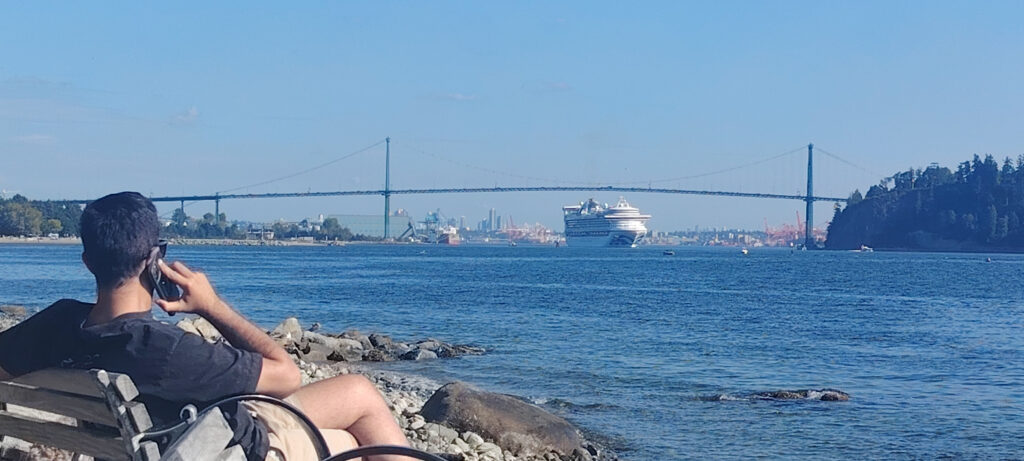
The Lions Gate Bridge spans the First Narrows of Burrard Inlet, connecting downtown Vancouver with the North Shore. It stretches 1.5 kilometers, its twin towers rise to 111 meters, and the deck hovers 61 meters above sea level. Its name comes from “The Lions,” the twin peaks that crown the North Shore mountains.
Construction began in March 1937, and the bridge officially opened on November 14, 1938—nearly ninety years ago. It was designed by the same engineer who created San Francisco’s Golden Gate Bridge. Initially privately owned, it was purchased by the Canadian government in 1955. In 2000, the bridge underwent a year-long restoration to widen the lanes and pedestrian sidewalks. On March 24, 2005, it was designated a National Historic Site of Canada.
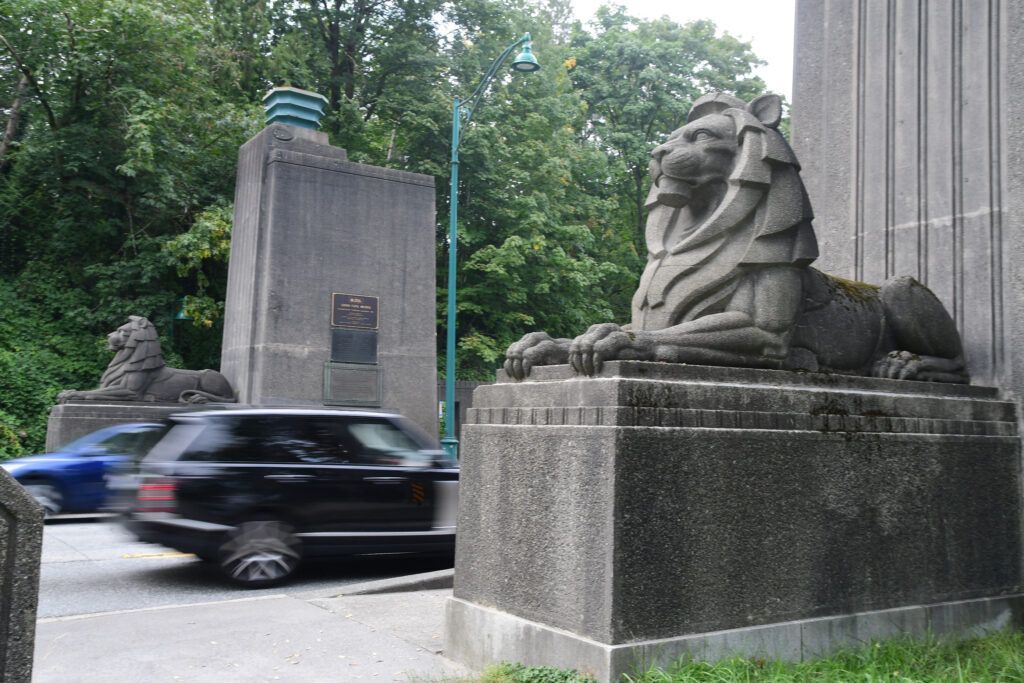
Automobiles have been widely used for just over a century, yet this nearly 90-year-old bridge remains one of Vancouver’s key arteries.
The Lions Gate Bridge reminds me of the Tsing Ma Bridge in Hong Kong—both are suspension bridges of roughly the same length. The latter, completed in 1997, is larger and structurally more complex. Yet the Lions Gate Bridge, built sixty years earlier and still carrying heavy traffic every day, deserves the highest respect for its designers and builders.
Despite my fear of heights, I once visited Stanley Park to walk across the bridge. Unlike Tsing Ma, the Lions Gate has pedestrian pathways where people stroll, jog, cycle, or walk their dogs while enjoying the view. But after stepping onto the bridge and walking only twenty or thirty meters toward the first tower, my knees began to weaken. The height was unmistakable, the surface quivered underfoot, and faint creaks echoed through the steel cables. I kept telling myself: this bridge has stood here nearly ninety years, carrying thousands of cars each day—surely, it won’t fail today. Yet, that small voice in my head insisted, “Leave now… hurry up!”
In Hong Kong, Victoria Harbour is crossed by three tunnels. When the Eastern Harbour Crossing was first proposed, some suggested building a bridge instead. Advocates believed a bridge would become a new city landmark and a draw for visitors, while critics argued that typhoons would make it unsafe, it could disrupt harbour traffic, and its cost would far exceed that of a tunnel. In the end, the government chose the tunnel.
From a practical point of view, the decision made sense. But still, one cannot help wondering—if a bridge had been built across Victoria Harbour, open to both vehicles and pedestrians, offering panoramic views of the city and sea—it might have become every bit as iconic as the Lions Gate, something no tunnel could ever replace.
I once came across a short piece of prose online about bridges. One line stayed with me:
“Walking across a bridge is passing commas in time;
The bridge itself is the eternal em dash—
Linking two shores that seem apart,
Knitting all the stories and poems, and
Travel between them.”
港燦在溫哥華之五 雨
溫哥華由深秋過渡到初冬的標誌,不是氣溫計上驟降的數字,而是一場來了便彷彿不再打算離開的雨。
它不像夏季的雨,來得暴烈,去得也乾脆;溫哥華初冬的雨,是一種彌漫在每一立方空氣裡的無所不在。它是矜持的,細如牛毛,隨風飄灑,將遠山近樹暈染成一片水墨的灰濛。空氣也似乎吸飽了水份,沉甸甸的,帶著腐殖土與濕透的松針那清冽而微涼的氣息。
街道上,柏油路面的顏色變得深沉,像吸墨的宣紙,將天光雲影都收納進去,映出兩旁建築與樹木朦朧的、流動的倒影。
不到下午五時,夜幕已提早垂落,城市的燈火逐一亮起,雨便顯露出它最為魅惑的容顏。那些紅的、黃的、白的燈光,全被雨水濡濕、拉長、打散,在平滑如鏡的積水窪裡,流淌成一片片破碎而璀璨的星河。車燈劃過,便在這星河裡犁出一道道轉瞬即逝的金色波痕。
此時的溫哥華,褪去了晴日下的明媚與張揚,像一個卸了妝的倦美人,顯露出幾分清寂,幾分疏離,卻又在這無邊的濕潤裡,滋長出一種內向的、沉思的溫情。
傘,成了人們手臂的延伸。步伐不再悠閒,多了些許目的明確的匆促。
巴士車窗玻璃上,總蒙著一層薄薄的水氣,將車廂內溫暖的燈光與人影,暈染成印象派的畫作。餐館的生意似乎也好了起來,隔窗望去,氤氳著白霧,人影幢幢,成了濕冷世界裡一個個誘人的、溫暖的標點。雨水敲打屋頂的沙沙聲,成了白日最恆定的背景音;到了夜裡,則化作催人入眠的、單調而安詳的搖籃曲。
在這彷彿無休止的濕潤包裹中,生命並未褪色,只是換了一種更為沉潛的方式。微風把紅透的楓葉都摘了下了,在地面鋪上了一層厚厚的地毯,細雨再給其加上一抹亮澤。草地依舊是執拗的綠,松針葉被雨水洗刷,綠得幾乎要滴下汁來。城市角落裡,耐寒的山茶已然鼓出飽滿的花苞,在雨中靜靜等待綻放的時機。
雨,固然濡濕了衣襪,拖慢了行程,卻也彷彿將時間的流速調緩了。它將天地籠進一個透明的水晶罩裡,隔絕了喧囂教人不得不向內審視,與自己的思緒相處。於是,這雨季的溫哥華,成了一座巨大的、流動的禪院。它在窗外淅淅瀝瀝的低語裡,供養著一種潮潤的靜謐,與一種在灰度中辨認細微光影的、安寧的敏感。
另:今日是母親85歲生日,僅以此文祝母親大人健康長壽。
Leave a Reply